


A few years ago, establishing a short-let business in Lagos appeared relatively straightforward. Investors could lease or purchase apartments, furnish them, advertise on Airbnb and Instagram, and attract diaspora visitors, business , couples, and local residents.
The model offered multiple bookings each month, unlike conventional tenancies with fixed annual rents. During peak periods, particularly in December, some operators could generate a significant share of annual rental income within weeks.
This potential attracted investment and supported market growth. In 2025, the sector generated an estimated ₦281.03 billion, up 6.3 per cent from ₦264.3 billion in 2024, according to Nairametrics. Ikoyi, Lekki Phase 1, Victoria Island, and Ikeja became key centers of activity.
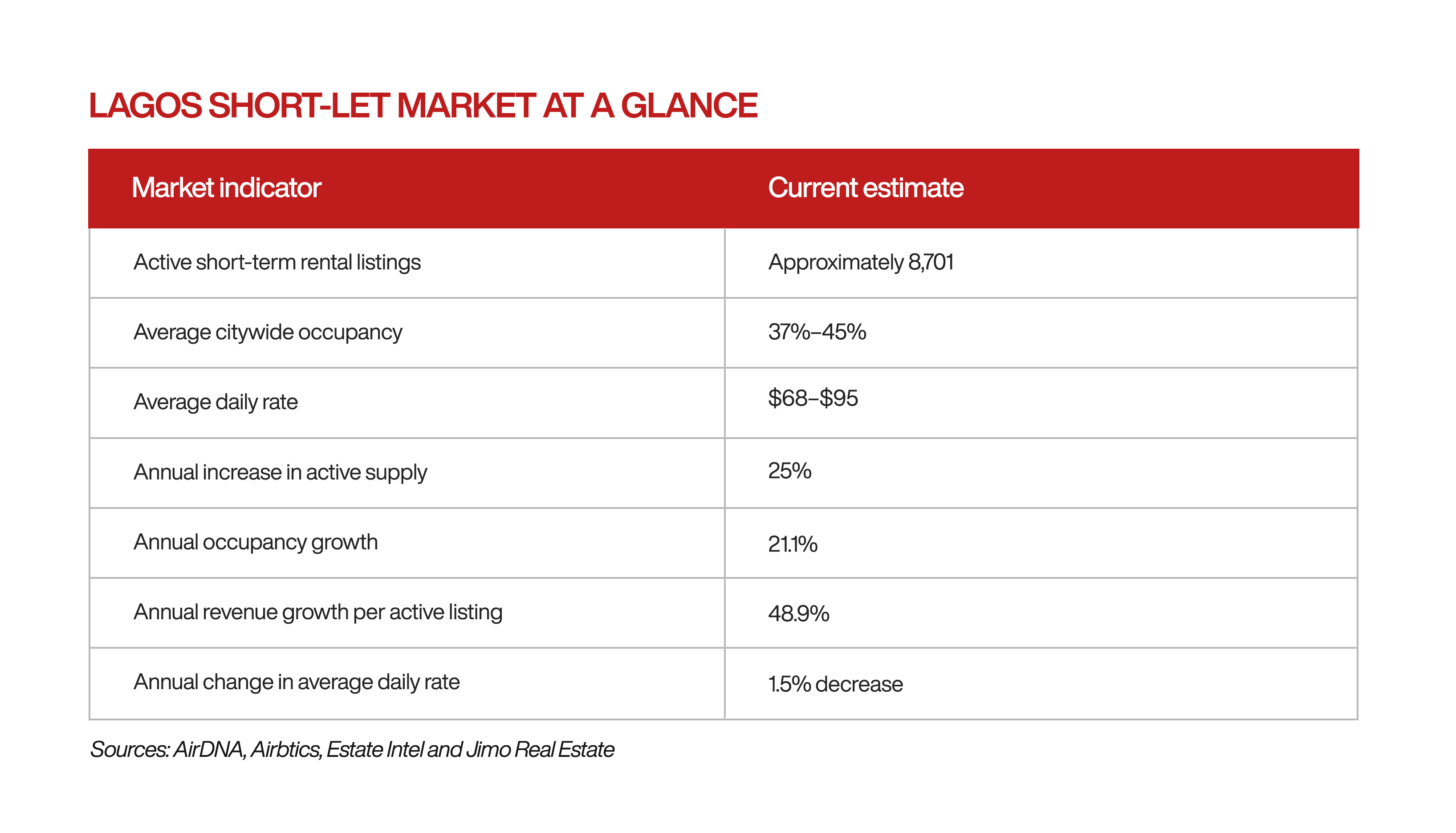
However, rising supply began to change market dynamics. As of June 2026, Lagos had approximately 8,701 active short-term rental listings—a 25 per cent year-on-year increase. Over the same period, occupancy rose by 21.1 per cent and average revenue per listing by 48.9 per cent, while average daily rates declined by 1.5 per cent, according to AirDNA. Demand and revenue remained strong, but competition intensified.
Greater choice also raised guests’ expectations beyond basic accommodation, while increased supply contributed to vacant nights, particularly outside peak periods. At the same time, operators faced higher electricity, fuel, cleaning, and maintenance costs. Some lowered nightly rates, introduced longer-stay packages or converted properties to annual tenancies; others left the market. Together, these pressures fueled the perception that Lagos’s short-let market was dying.
The available data, however, points to a market undergoing adjustment rather than collapse. Demand, occupancy, and revenue continue to grow, but increased supply has raised the standard for success.
For investors, the implications are significant. AirDNA placed average occupancy in Lagos at about 38 per cent in July 2026, demonstrating that overall market growth does not guarantee consistent bookings for every property. Attractive furniture alone is no longer sufficient. Airbnb data shows that guests frequently search for amenities such as Wi-Fi, air conditioning, parking, kitchens and self-check-in, while its ranking system considers ratings, reviews, customer service and ease of booking.
Location and lifestyle also influence demand. In a survey of 250 respondents, 39 per cent selected Lekki as their preferred location, according to Estate Intel, reflecting the appeal of its integrated business, dining and leisure environment. Operational demands are equally important. More than 80 per cent of bookings recorded in Lekki Phase 1 and Victoria Island lasted only one or two nights, according to a Lagos short-let market analysis, requiring frequent cleaning, responsive communication and consistent service.
Wider international industry data reinforces the commercial value of professional management. AirDNA found that professionally managed Vrbo Premier Host properties achieved 10.6 per cent higher average daily rates and 13.6 per cent higher revenue per available rental than comparable individually managed properties. Although these findings are not specific to Lagos, they illustrate the potential benefits of structured management.
Lagos’s short-let market is therefore shifting away from the basic furnished-apartment model towards professionally operated, hospitality-led accommodation that combines location, amenities, service and access to the city’s lifestyle.
For prospective investors, this requires more rigorous due diligence. Decisions should be based on realistic occupancy assumptions rather than peak-season performance alone. Investors must assess location-specific demand, competing listings, expected daily rates, operating costs, management fees, power requirements and regulatory restrictions before committing capital. They should also determine whether the property can offer a distinctive guest experience and remain profitable during off-peak periods.
The Lagos short-let market is not dying, but the era of easy returns is fading. Growth remains evident at the market level, while success at the property level increasingly depends on professional management, service consistency and financial discipline. Investors entering the sector must therefore approach short-lets not as furnished apartments that generate passive income, but as hospitality businesses requiring active and efficient operation.
We love your feedback! Let us know what you think about The Lagos Shortlet Market by emailing insights@jimorealestate.com.
If you are considering investing in Nigeria’s property market, contact our Investment Advisors team at investmentadvisors@jimorealestate.com.